Good morning after a great week of travel and meetings with The Big West staff! We enjoyed three productive days in Orem, Utah, for the quarterly staff retreat. My sincere thanks to Utah Valley University President Jon Anderson, his President’s Office staff and the entire athletics department for their generous hospitality. President Anderson provided meeting space, joined our staff for lunch and shared his enthusiasm for UVU’s membership in The Big West.
Our visit provided valuable opportunities to connect with UVU athletics administrators and coaches, strengthen relationships within our own team and advance our priorities for the 2026–27 academic year and upcoming championships. Spending time on a member campus reinforces the purpose behind that work: supporting our institutions and creating outstanding experiences for our student-athletes.
Following our time in Utah, I traveled to Phoenix, where Justin Jenkins, our Assistant Commissioner for Basketball Operations and Finance, and I attended the NCAA basketball officiating clinics as preparations continue for the approaching season.
Nationally, another consequential week brought NCAA Cabinet action on governance, recruiting and playing seasons. Of particular concern is the Cabinet’s approval of the two-semester men’s soccer model, which remains subject to a 30-day rescission period. More on that decision below.
Song of the week is "The Imperial March" written by John Williams for “Star Wars”. Consider it a little musical commentary on a weighted governance outcome that moved forward despite the concerns expressed by The Big West and most conferences and Division I conference commissioners.
Let’s get to The Bold Type!
CONGRATULATIONS!
- To Utah Valley men's cross country, ranked 20th in the latest USTFCCCA cross country poll. California Baptist is receiving votes in the listings.
- To our five Big West teams nationally ranked men’s water polo programs in the latest CWPA varsity poll!!
- No. 6 UC Irvine
- No. 7 Long Beach State
- No. 10 UC San Diego
- No. 12 UC Santa Barbara
- No. 16 California Baptist
- To Hawai?i Director of Media Relations Derek Inouchi has been elevated to Assoc. AD for Strategic Communications! Derek's bio >>>
- AND to our ATHLETES/PLAYERS OF THE WEEK!
- Women's Soccer - Malea Johnson, CSUN (offense); Maddie Buckley, UC Santa Barbara (defense); Jana Akins, CSUN (rookie)
- Men's Soccer - Enrique Pineda, CSUN (offense); Filip Arras, Cal State Bakersfield (defense); Oliver Watts, Utah Valley (rookie)
- Women's Volleyball - Ireland McNees, UC San Diego (offense); Whitney Wallace, UC Irvine (defense); Alexis Haury, Cal Poly (setter); Taylor Boice, UC Irvine (rookie)
- Cross Country - Itumeleng Ngxabazi, California Baptist (men); Melisse Djomby Enyawe, Cal Poly (women)
- Men's Water Polo - Luigi Canepa, UC Santa Barbara
“JOURNEY OUT WEST” WITH DAN TORTORA
This week’s guest “Journey Out West” with Dan Tortora was CSUN Director of Athletics Ryan Swartwood.
Wake Up Call starts at 6 a.m. PT daily, with Journey Out West each Friday beginning at 7:15 a.m. PT. MIXLR Internet Radio | YouTube | Facebook
SECURE YOUR SEATS TO THE 2026 BIG WEST MEN'S WATER POLO CHAMPIONSHIP AT LONG BEACH STATE
One of the nation's top men's water polo conferences meets in Long Beach, Calif., this November to battle for The Big West title and the league’s automatic berth in the National Collegiate Men’s Water Polo Championship. Secure your seats to see all six teams make a splash today! Read more >>>
THE BIG WEST CELEBRATES HISPANIC HERITAGE MONTH
CAL STATE BAKERSFIELD WOMEN'S BASKETBALL COACH RAY ALVARADO
Cal State Bakersfield head women's basketball coach Ray Alvarado sat down with Dan Tortora last month as the Dan and Ray had a larger conversation on Coach Alvarado's transition to the head chair of the `Runners this season. In this segment, the two talk about Hispanic Heritage Month and the importance of celebrating and sharing culture on a continuous basis and Ray reminiscences on picking peaches. Read more >>>
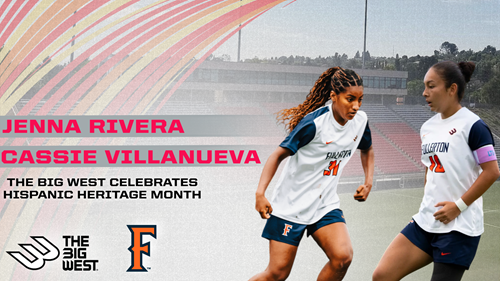 JENNA RIVERA AND CASSIE VILLANEUVA OF CAL STATE FULLERTON
For Cal State Fullerton student-athletes Jenna Rivera and Cassie Villanueva, heritage is woven into family, music, food, and the way they compete. Rivera proudly carries Mexican and Guatemalan roots shaped by sacrifice and resilience, while Villanueva’s African Mexican-American identity reflects generations of perseverance, cultural pride, and family connection. Together, their stories illustrate the strength found in honoring where you come from and carrying those roots into every space you enter. Read more >>>
"GREATEST RIVALRY" IN COLLEGE SOCCER
“Greatest Rivalry in College Soccer” Part 2 was played on Saturday night with 11,183 fans in attendance at Harder Stadium as UC Santa Barbara treated the home crowd to a 3-1 victory over Cal Poly to slip into the top spot on the 2026 single game attendance listings, edging out Part 1 by 108 fans. Earlier this year (Sept. 25), 11,075 (max capacity at Spanos Stadium) attended the rivalry match at Cal Poly, now tied for the 15th most attended NCAA men’s soccer regular-season match.
JOURNEY OUT WEST PODCAST WITH UTAH VALLEY DIRECTOR OF ATHLETICS JARED SUMSION
“Let's get back to valuing what a scholarship means instead of devaluing it and saying, 'Hey, I just need some NIL money so I can tell my friends that I'm getting NIL somewhere.’”
Utah Valley AD Jared Sumsion sat down with the Journey Out West podcast to discuss the university's move to the Big West and the financial realities of adding new sports to an institution with 48K students. Key takeaways…
-
Maintaining the value of a traditional athletic scholarship amid the rise of NIL compensation: "[We] do give out NIL. It's not a lot. It's not to a lot of people, but you come here to compete in the classroom and you come here to compete in competition and in the community and in life. ... Let's get back to valuing what a scholarship means instead of devaluing it and saying, 'Hey, I just need some NIL money so I can tell my friends that I'm getting NIL somewhere.'" (link)
A BOLD STEP FORWARD: PROTECTING OPPORTUNITIES AND THE FUTURE OF THE BIG WEST (LINK)
On Monday, I joined Dan Tortora for Episode 2 of A Bold Step Forward, our monthly conversation on Wake Up Call with Dan Tortora, to discuss the latest Collegiate Commissioner Association meetings, NCAA governance, basketball postseason opportunities and the future of college athletics.
Throughout the conversation, one priority remained clear: ensuring that The Big West’s institutions, coaches and student-athletes have a voice in the decisions shaping Division I. A few highlights follow.
Protecting Sport Sponsorship and Student-Athlete Opportunities
During Monday’s interview, I outlined The Big West membership’s opposition to the proposed two-semester men’s soccer model, which the Cabinet subsequently approved subject to rescission. Our concerns extend beyond moving another championship into an already crowded spring calendar. They include academic demands, student-athlete well-being, facility availability and the additional responsibilities placed on athletic trainers, game management personnel, SIDs and other campus staff.
There is also a broader concern: increased expenses could lead some institutions nationally to discontinue men’s soccer. At a time when athletics departments are managing settlement obligations, revenue sharing and other financial pressures, we must carefully consider whether a proposal intended to advance a sport could ultimately reduce opportunities to participate in it.
Although the proposal addresses men’s soccer, commissioners also discussed the possibility that women’s soccer could eventually seek a similar model, adding another layer of implications for institutions.
Basketball Postseason Access: The Numbers Tell the Story
As discussed during the interview, expanding the men’s and women’s NCAA Tournaments from 68 to 76 teams while reducing the NIT and WBIT from 32 to 24 leaves the combined number of opportunities unchanged: 100 for men and 100 for women.
The concern for The Big West and similarly situated conferences is where those opportunities will land. Scheduling challenges already make it difficult for our programs to secure games that strengthen the résumés used in postseason selection. Eliminating eight positions in each secondary tournament removes valuable opportunities for quality mid-major programs and their student-athletes.
During my service as chair of the Men’s Basketball Oversight Committee, I repeatedly raised questions about the impact of NCAA Tournament expansion on the NIT. I was assured the NIT is important to the NCAA and ESPN and there was never an indication that the field size would be cut. Protecting meaningful postseason access must remain part of the discussion.
An Informed Voice in NCAA Governance
Representing The Big West requires preparation, relationships and a willingness to speak up. We must understand the proposals, explain their impact on our institutions and support our positions with evidence.
My NCAA governance term has concluded, but that responsibility continues. Having served on the Council and Cabinet, I understand the importance of communicating directly with those who now hold those seats. We will continue to make our membership’s priorities known to the people making decisions on behalf of Division I.
The NCAA’s new governance dashboard must provide timely, meaningful access to committee agendas, materials, proposals and meeting reports. Brief summaries alone are insufficient when decisions carry significant academic, financial and operational consequences for our institutions. Members need clear explanations of what was considered, the rationale for decisions and the opportunities available to provide input or seek reconsideration. Transparency is essential to informed participation and confidence in NCAA governance. For accountability, the votes of each individual committee member should be provided.
Turning National Conversations into Useful Information
One of the most valuable aspects of commissioner meetings is the opportunity to compare experiences, ask questions and bring useful information back to our membership. Discussions concerning NIL, revenue sharing, governance and the College Sports Commission have direct implications for institutional planning.
That is a central purpose of This Week in The Big West: keeping our leaders informed as they make consequential decisions. The more information we can provide, the better prepared our membership will be.
Keeping the Student-Athlete Experience and Education at the Center
As financial differences across Division I continue to grow, The Big West must continue improving the student-athlete experience on our campuses, throughout the regular season and at our championships.
We must also preserve the educational foundation of college athletics. In discussing federal legislation, I emphasized the importance of enforceable membership-approved rules, academic standards and a clear eligibility framework.
My message to student-athletes remains straightforward: take full advantage of the opportunity. Earn that degree. Pursue another if you can. The value of an education extends well beyond a playing career.
We will continue to advocate for a BOLD and successful Big West—protecting opportunities, supporting our institutions and keeping the long-term interests of our student-athletes at the center of our work.
Watch the full conversation with Dan Tortora.
NCAA MEN'S SOCCER OVERSIGHT COMMITTEE AND CABINET APPROVE FULL-YEAR MEN'S SOCCER
The Division I Cabinet on Wednesday reviewed and affirmed a proposal that was previously adopted by the Division I Men’s Soccer Oversight Committee to shift the playing season in men’s soccer to a year-round model, with competition segments in both the fall and spring seasons and the championship occurring in the spring.
However, because the Cabinet did not approve the proposal with 75% of the vote, it will now go into a 30-day rescission period, during which any of the eligible Division I schools or conferences can submit a vote to defeat the proposal. At the end of the 30-day window, if two-thirds of DI members (at least 245 schools and/or conferences) do not rescind the rule change, it will take effect, and the men’s soccer season will move to the year-round model starting with the 2027-28 academic year. I strongly believe this should be only those institutions that sponsor men’s soccer, but based on this release, it seems it is based on the FULL NCAA membership.
In June, the Cabinet considered the proposal and remanded it back to the men’s soccer committee for additional information about expected impacts on midyear enrollees and broader scheduling challenges at the school level. The committee provided feedback to the Cabinet on those items, and the Cabinet during their meeting this week was generally satisfied that the new schedule would be manageable.
The year-round playing season has long been supported by stakeholders in the men’s soccer community as a better way to develop talent in the sport. Advocates — including student-athlete representatives who serve on the Cabinet — also have argued that it would allow more time for rest and recovery between games for men’s soccer student-athletes, in addition to reduced weekday travel.
If ultimately implemented, the new season also would result in the notification-of-transfer window for men’s soccer occurring after the conclusion of the championship in the spring.
Under the new schedule, the men’s soccer regular season would be distributed over two semesters, maintaining the current limit on total games per year at 25. Teams would have the opportunity to schedule and play up to 18 games during the fall segment (starting in late August and concluding the week before Thanksgiving) and up to 10 games during the spring segment (starting in mid-February).
While awaiting the conclusion of the 30-day rescission period, the oversight committee will begin exploring implementation of the new rules by working with NCAA staff and broadcast partners to identify when the championship might occur during the spring semester.
The Division I Women’s Soccer Oversight Committee reviewed the proposal and ultimately declined to propose a similar change in women’s soccer.
The rescission period ends at 5 p.m. Eastern time on November 6, 2026. Membership action can make a difference. The previously approved change permitting betting on professional sports was rescinded after two-thirds of Division I member schools supported rescission.
NCAA CABINET OUTCOMES FROM OCTOBER MEETINGS
Legislative Actions.
-
Decentralization and Modernization. The NCAA Division I Cabinet introduced legislation into the January 2027 legislative cycle for decentralization and modernization of the legislation in NCAA Bylaws 11, 13 and 17.
Bylaw 11. The cabinet introduced legislation to eliminate the restriction on the number of countable coaches and student assistant coaches in all sports, strength and conditioning coaches and graduate student coaches in bowl subdivision football. Schools can contact the NCAA about any current effects the legislation is having on its staff. The cabinet also introduced legislation to eliminate the restriction on athletically related income and benefits, compensation and renumeration and requirements to recruit off campus in Bylaw 11. Limits on off-campus recruiters would be maintained by moving existing coaching limits to Bylaw 13 (recruiting).
Bylaw 13. The cabinet introduced legislation to permit transportation, accommodations and entertainment for a prospective student-athlete and up to four individuals on an official visit.
Bylaw 17. The cabinet introduced legislation to create standardized first practice, competition and end of season dates. Specifically, this proposal will: 1) eliminate preseason practice legislation in all sports to establish a standard start date on which each sport is permitted to conduct transition periods, preseason or in-season countable athletically related activities; 2) amend first contest/date of competition legislation to establish a standard date on which an institution is permitted to conduct its first competition against an outside team after an established preseason practice period; and 3) establish a standard date on which an institution must cease in-season countable athletically related activities. Additionally, the cabinet introduced legislation to eliminate the restrictions on in-season foreign competition.
Rationale: The NCAA Division I Decision-Making Working Group and the Division I Board of Directors identified decentralization and modernization of NCAA legislation as necessary to adapt to the changing landscape of collegiate athletics.
Effective Date: July 1, 2027.
-
Professional Participation Before Period of Eligibility. The cabinet introduced legislation into the January 2027 legislative cycle to amend how current rules apply to professional participation that occurs before an individual’s period of eligibility begins. The proposed changes would no longer preclude compensation received before the individual’s period of eligibility begins. Once an individual’s period of eligibility begins (after full-time enrollment, or turning 19, whichever occurs first), existing rules around professional participation would continue to apply and be used to assess Division I eligibility.
Effective Date: If adopted, the proposed changes would be used to certify student-athletes initially enrolling full-time in a collegiate institution on or after August 1, 2027.
-
NCAA Division I Proposal No. 2026-27 – Playing and Practice Seasons – Men’s Soccer – Redistribution of Men’s Soccer Playing Season Model. The cabinet adopted Proposal No. 2026-27, in men’s soccer to redistribute the men’s soccer playing and practice season across the fall and spring semesters and move the NCAA Division I Men’s Soccer Championship to the spring. The proposal is effective August 1, 2027.
Because the proposal was adopted with less than a 75% majority, it is subject to a 30-day rescission period, which ends at 5 p.m. Eastern time, November 6, 2026.
-
Proposal No. 2026-48 – Recruiting – Precollege Expenses – Complimentary Admissions to Away-From-Home Athletics Events – After Commitment. The cabinet amended and adopted Proposal No. 2026-48 to specify that, in baseball, men’s and women’s basketball, field hockey, men’s ice hockey, men’s and women’s lacrosse, men’s and women’s skiing, men’s and women’s soccer, softball, and women’s volleyball, after an individual has signed the institution’s written offer of admission and/or financial aid or a settlement related benefits agreement, or after the institution has received the individual’s financial deposit in response to its offer of admission, the institution may provide the individual (or the individual’s relatives or legal guardians) with a maximum of three complimentary admissions (issued through digital ticketing or a pass list) to an away-from-home event, in their sport, in a facility in the locale of the individual’s home or educational institution. The proposal is effective immediately.
-
Proposal No. 2026-53 – Recruiting – Contacts and Evaluations – Division I Contest Attendance Restriction – Men’s Basketball and Football. The cabinet amended Proposal No. 2026-53 to include football and adopted the proposal, as amended. The proposal specifies that, in men’s basketball an institutional staff member with responsibilities specific to men’s basketball shall not attend a Division I men’s basketball preseason contest, regular season contest or a contest of a conference tournament, unless the contest is one in a tournament or event in which the institution’s team is participating, or the contest involves a family member of the institutional staff member as a participant. In football the attendance restriction applies to institutional FBS and FCS staff with football-specific responsibilities, with FBS and FCS-specific exceptions. The proposal is effective immediately.
-
Proposal Nos. 2026-57 (Playing and Practice Seasons – Bowl Subdivision Football – Out-of-Season Activities and Preseason Practice Period) and 2026-59 (Playing and Practice Seasons – Championship Subdivision Football – Out-of-Season Activities and Preseason Practice Period). The cabinet remanded Proposal Nos. 2026-57 and 2026-59 to the NCAA Division I Football Bowl Subdivision Oversight Committee and Football Championship Subdivision Oversight Committee respectively for further review. The cabinet charged the football oversight committees with review of the February 1 start date for noncontact skill instruction and out-of-season practice, and whether an institution’s off-season start date should be tied to conclusion of their previous season.
-
Proposal No. 2026-45 – Governance Structure and Committees – Updated Division I Legislative Process. The cabinet adopted Proposal No. 2026-45, to establish a legislative process that supports the goals of the new Division I governance structure. The proposal is effective immediately for the January 2027 legislative cycle.
-
October 2026 Legislative Cycle and Expedited Proposals. Actions taken on other proposals in the October 2026 legislative cycle and proposals considered as expedited legislation are included in the Attachment.
Nonlegislative Items.
MEDIA REPORTS ON THE BIG WEST, NCAA, LEGAL AND LEGISLATIVE UPDATES
- Newly appointed Cal State Bakersfield AD Andy Fiske addressed the university community during his introductory press conference, during which he outlined his vision to establish the program as the primary sports and entertainment destination in Kern County. D1.takeaways…
- Travel and competitive advantages of the Big West: "This is a winnable conference. We could win conference championships and make NCAA runs from this conference. The other thing I really like about this; to be candid, you look at Cal and Stanford, they're flying their volleyball team all the way back East. ... Our conference is ideal for short drives in and out. It lets them be truly student-athletes and have that balance of life that's needed."
- Adapting to the modern landscape: "So, in this new world of college athletics with NIL, rev share, conference realignment, if you would have told me about this 10 years ago, I would have said, 'You're crazy. That's not college athletics.' But that's where we are. We're going to have to be creative. We're going to have to do things unique and different just like all the other universities out there. ... We might have to be a little bit disruptors to be successful."
- Establishing priorities for his first 90 to 100 days: "I think it's going to be important to take the first 90 to 100 days and listen, talk with our coaches, talk with our student-athletes, talk with our administration, talk with our partners on campus, and talk with stakeholders in the community. Where are our opportunities? Where are our challenges? What are we doing well? How do we grow upon that?" (link)
- Cal Poly extends its apparel partnership with Adidas, while naming Game One as its official collegiate team dealer. The agreement provides uniforms, apparel and equipment across all 22 of the Mustangs’ Division I programs. (link)
- NCAA President Charlie Baker believes the Protect College Sports Act still has a strong chance of House action after the midterms despite concerns about the legislation’s passage. Speaking at Puck’s In the Arena conference, Baker stopped short of predicting it would pass in the upcoming lame-duck session, per SBJ’s Ben Fischer, arguing the bill was ripe for serious consideration as part of political horse trading between Senate and House leadership. “There’s a whole bunch of stuff the House has passed that’s sitting in the Senate. There’s a whole bunch of stuff the Senate’s passed that’s sitting in the House ... I don’t know if we end up being part of those conversations or not, but I think it’s just as likely as not that we will, because we are something that got a profoundly significant overwhelmingly positive vote in the Senate.” Asked by Puck’s John Ourand about which parts of the bill he doesn’t support, Baker responded: “When I was governor, I signed hundreds of bills. I never signed a bill that was perfect. There’s always stuff in there you don’t like, OK? That’s called democracy. I think this thing is much better for college sports than not.” (link)
- The Sun Belt is expanding its partnership with Trackman to debut the Automated Ball-Strike (ABS) Challenge System during baseball conference play and introduce in-game data and analytics delivery to softball coaches and staff via in-dugout tablets in 2027. (link)
- The Division I Men’s and Women’s Basketball Oversight Committees have introduced a legislative package focused on out-of-season activities, including a new opportunity for limited domestic summer competition against four-year college teams. The proposal standardizes summer competitions to a maximum of three dates, either foreign or domestic, during the eight-week summer access period when college basketball teams are practicing and developing on campus. This provides all DI teams with flexible, efficient and equitable opportunities without counting toward weekly summer hourly limits or requiring summer course enrollment for eligible student-athletes. Additionally, the proposal allows student-athletes to participate on noncollegiate amateur outside teams following their respective national championship until official practice begins in September, provided it takes place outside the eight-week summer access period. While the WBOC supports maintaining the current eight hours per week for summer access, the MBOC proposed an increase to 10 hours per week due to high annual roster turnover and the need for additional development time. The proposals may be amended based on membership feedback before oversight committee votes in December and DI Cabinet review in January, targeting a potential effective date of April 2027. (link)
LET'S CLOSE IT OUT!
This week took us from conversations with university leaders and coaches in Orem to preparations with basketball officials in Phoenix. Both reinforced an important point: successful seasons and meaningful student-athlete experiences begin with people who prepare, collaborate and care about getting the details right.
That same commitment must guide our response to national change. We will continue to study the proposals, explain their consequences and make our membership’s positions heard. When there is an opportunity to influence an outcome, we must be prepared to act.
Thank you to the administrators, coaches, officials and campus staff whose work makes these opportunities possible. Congratulations to our student-athletes who continue to give us so much to celebrate.
The road ahead will require persistence and adjustments, but our purpose remains clear.
Together, we will keep building a BOLD and successful Big West.
QUOTE OF THE WEEK
Don’t quit….Have you ever noticed your GPS never admits defeat? It just recalibrates! – Attributed to Loren Ridinger.
Dan