Watch the video >>>
Black History Month is an annual observance dedicated to celebrating the achievements, contributions, and history of African Americans and people of African descent.
Black History Month serves as a platform to highlight the achievements of individuals who have made significant impacts in various fields, including science, literature, arts, politics, and civil rights while promoting awareness, education and understanding of the Black experience. The month encourages people to reflect on the challenges faced by African Americans in their pursuit of equality and justice, fostering a greater sense of unity and cultural pride. Ultimately, Black History Month stands as a testament to the resilience and enduring legacy of the African American community.
Celebrating Black History Month with The Big West is UC Santa Barbara assistant women's basketball coach Krystle Evans. The 2010 UCLA graduate has coached in both the prep and collegiate settings throughout the state before joining the Gauchos staff for a second stint on head coach Bonnie Henrickson's bench. The director of basketball operations for UCSB in 2015 as part of Henrickson’s inaugural staff, Evans returned to the program as an assistant coach in July 2022.
How do you use your sport as a form of expression?
I currently work as an assistant women’s basketball coach at the UC Santa Barbara and enjoy the satisfaction of motivating individuals to improve their lives. I believe that helping people is my purpose in life and coaching allows me to help people. I want to be able to leave behind a legacy of inspiration. Black women are significantly under-represented in sports coaching and administration, especially at the elite levels and the highest levels of coaching accreditation/teaching. As a Black woman, coaching at a predominantly White institution, I can further the conversation on Black women in sports leadership positions at PWIs.
What are some challenges you've faced as a Black individual, and how have you overcome them?
I was 1 of 96 African Americans admitted into UCLA in 2006. As a first-generation college student, majoring in political science (a majority-male discipline), while being 1 of the infamous 96... I initially felt out of place, then I felt like I had more pressure to succeed and not let my race down. My sophomore year I pledged Delta Sigma Theta Sorority, Inc., where I was surrounded by women who taught me how to succeed in environments where you may be the only woman, or person of color. Growing my network, finding relatable mentors, and staying grounded in my faith has helped me overcome every obstacle I've faced.
What advice would you have given yourself as young Black athlete or young Black professional?
Advice I would have given to myself as a young Black athlete/young Black professional, "decide what you want, then work your Black girl magic to make it happen."
How do you think college athletic programs can better support and represent Black athletes/staff and their experiences?
College athletic programs can better support and represent Black athletes/staff and their experiences by being intentional about increasing Black representation. Increasing Black representation would also be a positive step in eliminating deficit approaches. Another step in mitigating deficit-laden assumptions is finding ways to incorporate faculty members for informal relationship building with Black athletes.
Who is a Black administrator, coach, or athlete that you look up to and why?
A Black coach I look up to is Trisha Stafford-Odom. Coach "Trish" is from my hometown, Los Angeles, and graduated from UC Berkeley. She was the first Black coach I met that I could relate to. Watching her navigate predominantly White institutions as a coach, knowing she did the same thing as a student-athlete gave me the confidence that I could do it too. I get emotional thinking about how much she inspired by SHOWING me that WE belong... that WE are worthy. ''
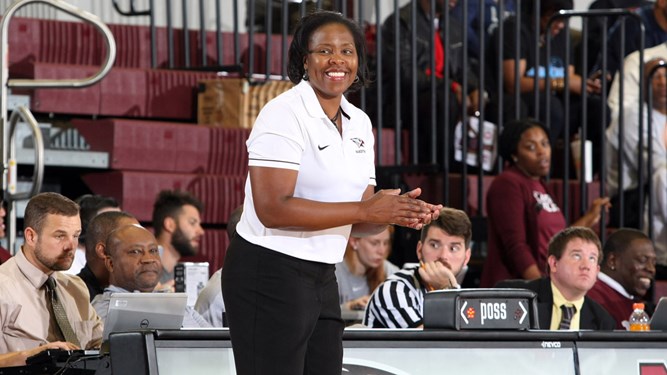 Trisha Stafford-Odom, North Carolina Central head coach
What would you like to say about Black History Month that we didn’t ask?
Black history exposes and expounds on the full spectrum of humanity: beauty, sadness, joy, perseverance, and love.